Stop Treating the PRD as Alignment
A guide to replace the “final spec” handoff with staged alignment, checkpoints, and a living source that cuts rework.

The myth says a perfect spec equals alignment. You write it. You hand it over. Work flows. In real teams, that handoff often starts the churn. This guide shows a better way.
One final spec handed to engineering creates alignment and prevents rework.
Alignment comes from staged artifacts and checkpoints. Make intent, constraints, and decisions explicit over time. Keep a living source.
Who this is for and what you will have at the end
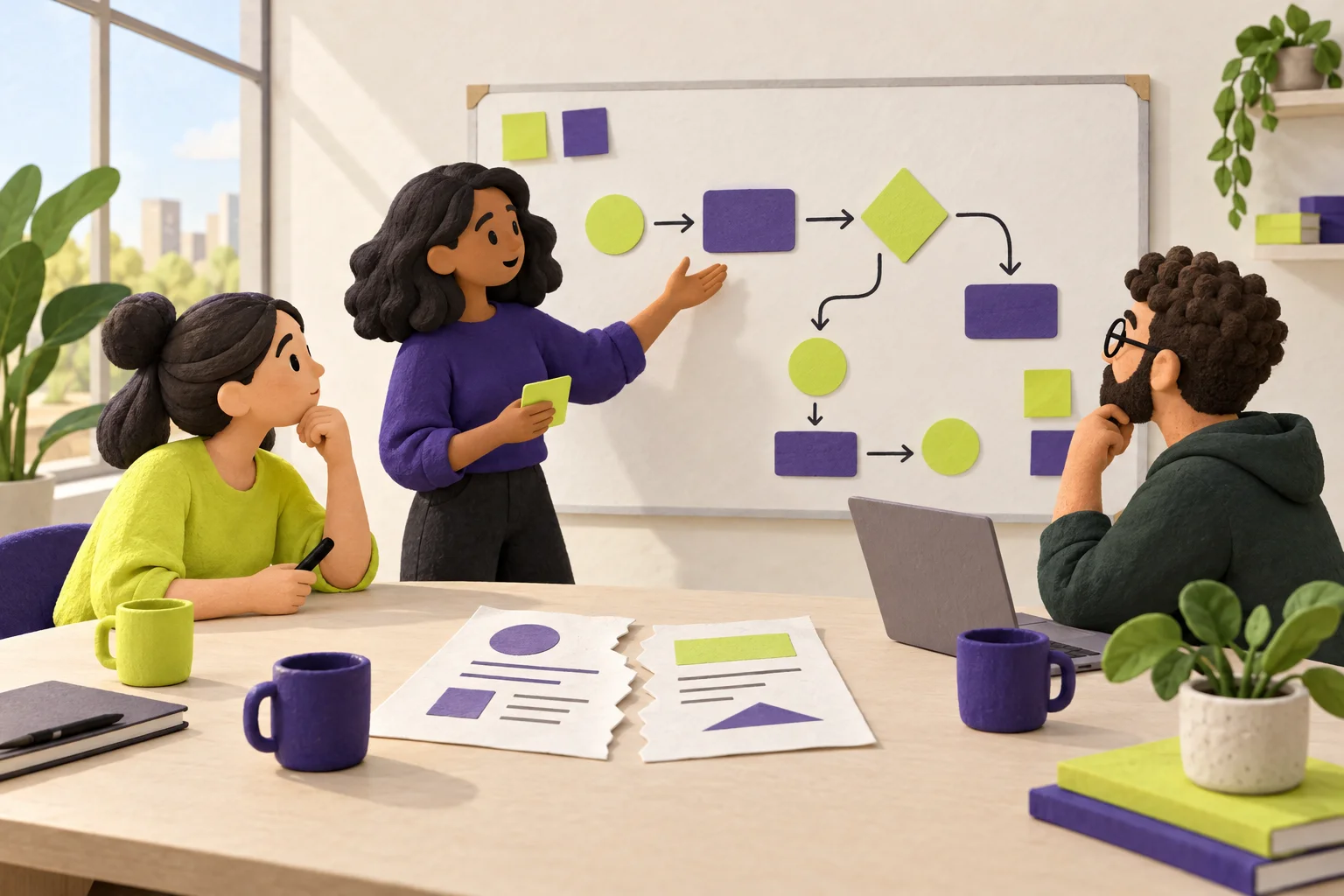
This guide is for product managers who coordinate design and engineering on non‑trivial features. By the end, you will have a three‑checkpoint workflow, a set of staged alignment artifacts, and a living source stack you can run on your next project.
Where the “final spec” breaks
- Late discoveries. Third‑party APIs differ from docs. Data is messy. Latency shows up in the worst step.
- Ambiguous UX intent. A wireframe hints at a flow but not the goal, the edge cases, or the tradeoffs.
- Hidden technical constraints. Infra limits, mobile quirks, or sequencing risks surface during build.
A single handoff turns into a rework contract the moment these show up.
- Replace the “final spec” with staged artifacts: intent, constraints, decisions, experiments.
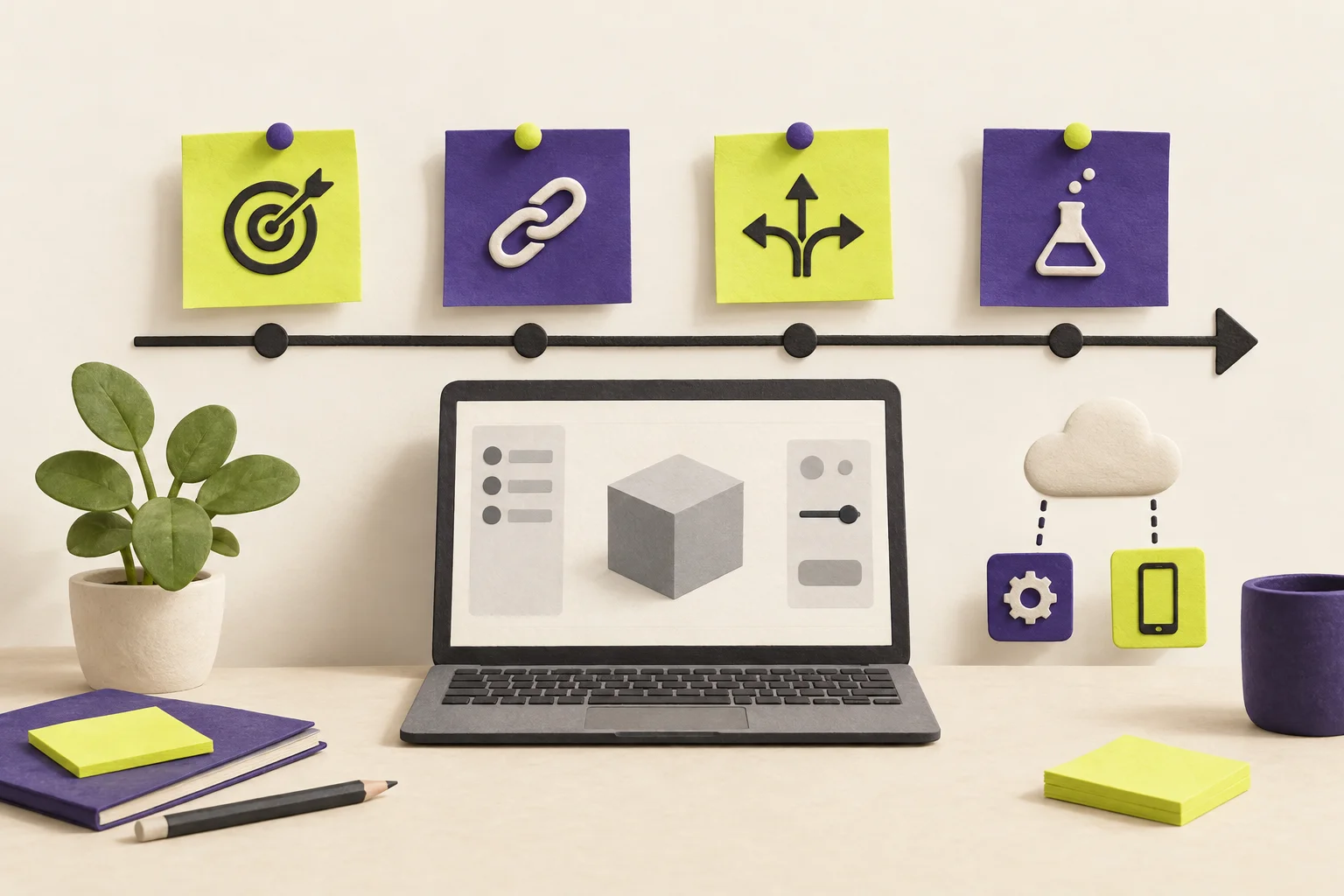
- Use three time‑boxed checkpoints: intention, constraint, integration.
- Make the least‑fragile artifact the source: an interactive prototype, a decision log, and acceptance experiments.
Documents do not align teams. Conversations, decisions, and runable evidence do.
The staged alignment stack
Do not aim for one finished document. Build four simple artifacts over time.
- Intent: what outcome we want, for whom, and how we will know. Keep it short.
- Constraints: what can break it. Known limits in APIs, data, performance, compliance, and devices.
- Decisions: the tradeoffs we are choosing now, and why. Dated entries. One line each.
- Experiments: small, time‑boxed tests to prove a risky behavior or integration.
Three checkpoints that replace the handoff
Use short, goal‑focused checkpoints. Time‑box each. Decide what must be true before moving on.
Intention review
Goal: shared clarity on the user problem, outcome, and scope. Show a 10‑minute prototype. Call out what is not modeled yet.
Exit: we agree on success criteria and on what we will not do now.
Constraint review
Goal: surface system and third‑party limits before detailed design. Walk an infra checklist with engineers.
Exit: a list of hard limits, open questions, and fast experiments to run.
Integration review
Goal: run the flow end‑to‑end in a demo environment. Confirm acceptance experiments pass.
Exit: a go/no‑go on build scope, with a test plan and a clear decision log.
For the intention review, a structured Design review helps frame user goals and non‑goals.
What you make vs what you used to make
| Final spec handoff | Staged alignment |
|---|---|
| One long PRD or wireframe deck, treated as “final”. | Short intent note, constraint list, decision log, and small experiments. |
| Assumes completeness before engineering input. | Pulls engineering into intention and constraint reviews early. |
| Changes feel like failure and scope creep. | Changes are expected at planned checkpoints. |
| Source of truth is the doc. | Source of truth is the proto + decisions + tests. |
| Risk is invisible until build. | Risk is isolated by experiments before build. |
Checklist
Do
- State the user outcome and non‑goals first.
- Show a clickable prototype early, even if rough.
- Run an infra and integration checklist with engineers.
- Write one‑line decisions with the date and why.
- Time‑box small experiments to de‑risk key steps.
- Use checkpoints to set what must be true to proceed.
Avoid
- Treating specs like legal contracts.
- Waiting for “complete” wireframes to talk to engineering.
- Burying tradeoffs in footnotes or appendix slides.
- Skipping experiments that would surface a constraint.
- Letting the doc drift while the prototype changes.
Worked example: checkout redesign with three checkpoints
Context: a payments checkout redesign. The old flow is desktop‑first. The team plans to ship new address and payment steps. Risks include third‑party API limits, latency on mobile networks, and a mobile ordering flow that was not modeled in the first pass. Here is how to run it.
1) Intention review: intention doc + 10‑minute prototype
- Intent: reduce checkout drop‑off and errors. Focus on mobile users. Success is a lower abandon rate at payment and fewer failed submissions.
- Prototype: a 10‑minute grey‑box clickthrough of the new address and payment steps. Show the happy path only. Call out what is not included yet: guest vs account flow, and saved cards management.
- Non‑goals: no loyalty program changes in this release. No new payment methods in scope.
- Decisions logged: keep address and payment on separate screens for now; declutter payment step by deferring promo codes to an earlier step.
Exit: the team agrees on success criteria and on the scope cut. Design notes which mobile gestures and device behaviors to model next. Engineering flags that third‑party calls and latency need a deeper look.
2) Constraint review: with engineers and an infra checklist
- Walk the flow against known limits: third‑party API rate limits, field validation rules, token lifetimes, and 3‑D Secure redirects.
- Check mobile constraints: slow network timeouts, keyboard behaviors, and resume after app switch.
- Identify experiments: a quick test that simulates slow network on the payment step, and a stub against the third‑party API to confirm field combinations and error codes.
- Decisions logged: pre‑fetch address suggestions earlier in the flow; show a non‑blocking loader on payment submit; add a recover step for 3‑D Secure timeouts.
Exit: a dated constraint list and two small, time‑boxed acceptance experiments to run before integration review. The prototype is updated to include the recover step and mobile keyboard behavior.
3) Integration review: runnable demo + test plan
- Demo: run the mobile checkout on a device against a sandbox. Show happy path and the two risky cases: slow payment response, and a 3‑D Secure redirect that times out.
- Experiments: show passing results for the slow‑network simulation and the API field validation stub.
- Test plan: list acceptance checks the team will keep during build, including resume after app switch and error messaging for the third‑party limits.
- Decisions logged: proceed with current scope; split out saved card management to a later release; keep the recover step as a separate screen.
Exit: go on build with known limits, a decision log, and a test plan tied to the demo. No one is guessing what “final” means. The living source is the prototype, the decisions, and the acceptance experiments.

Make the least‑fragile artifact the source
Long docs go stale. Your source should be hard to misread and easy to run. In this workflow it is three things:
- Interactive prototype: the current single source for UX intent. If the prototype and doc differ, the prototype wins.
- Decision log: short, dated entries that say what changed and why. Easy to scan. Easy to cite.
- Acceptance experiments: small tests that prove risky behaviors or integrations. If an experiment breaks later, you know what to fix.
Keep the PRD short. Link to the prototype, the decisions, and the experiments. Those hold alignment better than prose.