Blend Your AI Stack Like a Winemaker
Treat base models like varietals. Design, test, and iterate AI blends to get measurable gains, cost control, and a defensible product edge.

This is for working PMs deciding whether to build, buy, or wrap models for a feature. You will leave with a repeatable way to blend base models, measure the blend, and iterate toward a moat built on recipes, data, and ops — not model exclusivity.
- Treat base models like wine varietals. Blend small, measurable recipes.
- Set tasting metrics up front: latency, cost, accuracy on critical intents, hallucination, retrain latency, and ops overhead.
- Use three blend patterns: upstream ensemble, downstream augment, wrapper adapters.
- Run blind tasting panels with pre-set thresholds. Iterate by slice, not global lift.
- Build moats from unique data, structured outputs, caching, and governance.

Why blend, not bet
Major base models look similar to users. A naive choice, like always picking the largest model, erodes margin and offers little edge. Blending keeps you flexible. You pick a few models, define how they share traffic, and measure the result at request and segment levels. You keep what proves out. You drop what does not. You avoid a one-shot architecture that is hard to reverse.
The steps, in order
Write the product job-to-be-done and the critical intents. List 2–4 base models across sizes. Treat each as a varietal with clear strengths. Propose 2–3 small recipes that split traffic by rule or router. Keep each recipe simple enough to measure.
Pick metrics before you test: latency, token cost per request, accuracy on critical intents, hallucination rate on safety tests, retrain latency, and deployment ops. Measure by request and by user segment. Decide the data slices that matter: new users, high-value accounts, sensitive topics.
Use one of three patterns. Upstream ensemble: a reranker or router feeds a small model. Downstream augment: an LLM with retrieval and domain rules. Wrapper adapters: a host model plus targeted fine-tunes or prompts. Note expected trade-offs and how you will record them.
Write thresholds now. Example: median latency < 700 ms; token cost ≤ $0.08 per ticket; hallucination < 1% on safety tests; resolution lift ≥ 12% vs baseline. Use these to stop bad blends early.
Do cross-functional micro-pilots. Mask which blend a rater sees. Pre-register decisions and sample sizes. Compare specific slices with A/B, not just global lift. Keep a log of each run with inputs, outputs, and costs.
Instrument component SLIs: router, retriever, model, post-processor. Cap model spend per user-week. Plan retrain cadence. Keep a simple rollback recipe and a safe fallback path.
Use the data. Keep wraps where prompts or small fine-tunes hit thresholds with headroom. Build when your private signals or rules drive clear gains. Buy where a hosted model meets needs with margin and operational fit.
Harden unique data blends, structured outputs, latency-sensitive caching, and governance. Document the recipe so a new model swap does not erase your edge.
The three blend patterns
| Pattern | Core idea | When it fits | Trade-offs to watch |
|---|---|---|---|
| Upstream ensemble (reranker + small model) | Use a lightweight router or reranker to pick or filter inputs, then let a smaller model answer. | High volume, tight latency, many easy queries with a long tail of hard ones. | Latency often low; cost profile often low; accuracy may dip on rare intents without careful routing. |
| Downstream augment (LLM + retrieval + rules) | Ground the model with retrieval and enforce domain rules for outputs. | Knowledge-heavy tasks, compliance, need for citations or structured fields. | Latency depends on retrieval; cost depends on context length; accuracy improves on domain facts, but rule conflicts need testing. |
| Wrapper adapters (host + fine-tune or prompts) | Keep one host model and adapt with focused fine-tunes or prompt templates per task. | Clear task clusters and stable intent taxonomy. | Ops overhead for variant management; risk of drift; fast to ship small wins. |
Whichever pattern you start with, record accuracy on critical intents, median and p95 latency, and token cost per request. Track hallucination on safety tests. Note retrain latency and deployment complexity for each component.

How to run tasting panels
- Define the panel: PM, Eng, Design, Ops, Legal if safety is in scope.
- Blind the runs: mask which blend produced each output.
- Use pre-set thresholds as gates, not after-the-fact justifications.
- Compare by slice: segment, intent, language, or channel.
- Record per-request logs: input, retrieval hits, prompts, output, latency, tokens, decision.
- Automate where you can. An AI agent can drive repeatable evaluation runs.
Operational guardrails
- Budget guard: cap model spend per user-week and per segment.
- SLIs: router hit rate, retrieval recall, model accuracy on critical intents, post-processor pass rate.
- Safety: hallucination rate on safety tests below threshold; deterministic fallback for sensitive flows.
- Retrain cadence: schedule data refresh and fine-tune windows; track retrain latency.
- Rollback: keep a simple, tested recipe one click away.
- Caching: latency-sensitive caches with expiry tied to content change, not time alone.
- Explainability: log which components and rules shaped each answer.
Common mistakes to avoid
- Optimizing only for accuracy while ignoring cost and ops.
- Making a single permanent architecture choice without short, testable blends.
- Assuming proprietary model access equals a moat.
- Under-instrumenting blended components, so you cannot see where errors or costs arise.
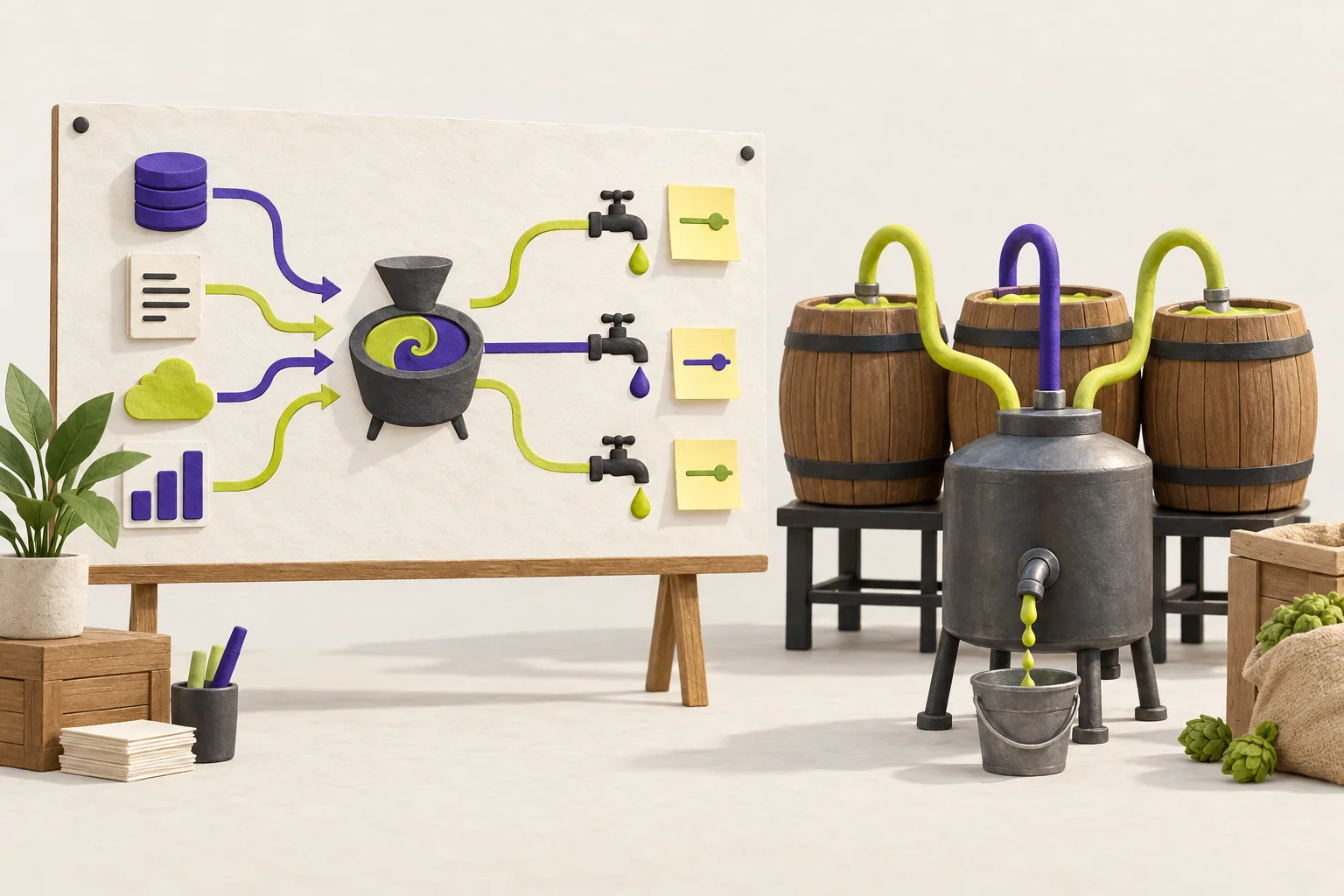
Worked example: a customer-support assistant
Start with a 60/30/10 recipe:
- 60% of traffic: a retrieval-augmented LLM for complex or novel queries.
- 30% of traffic: a local distilled model for canonical knowledge base answers.
- 10% of traffic: a deterministic rule fallback for billing questions.
Define tasting metrics and thresholds:
- Per-ticket resolution time.
- Escalation rate.
- Cost per ticket, with token cost ≤ $0.08 per ticket.
- Median latency < 700 ms.
- Hallucination < 1% on safety tests.
- Resolution lift ≥ 12% vs baseline.
Run a two-week micro-pilot. Blind-rate outputs on critical intents: refunds, account access, shipping, and legal. Capture per-request logs and segment by plan tier and language.
If total cost is above target, pivot the proportions. For example, increase the local distilled share to 50% and reduce retrieval-augmented LLM share. Re-run the same tasting sheet. Compare deltas by segment, not just the global average.
Keep the blend that meets thresholds with margin. Document the recipe: routing rules, retrieval sources and freshness, prompt templates, and fallback triggers. Set retrain cadence for the distilled model and content refresh cadence for retrieval.
From blend to build/buy/wrap decision
Use the tasting results to decide scope:
- Buy: a hosted model meets thresholds with stable costs and low ops overhead.
- Wrap: prompts or light fine-tunes on a host model deliver gains on your key intents.
- Build: your private signals, retrieval, or rules create measurable lift that general models do not match.
Lock in the moat by making the data sources and operational recipe hard to copy. Focus on private signals, structured outputs that plug into your workflows, and caches tuned to your latency and freshness needs. Keep your swap path ready so a model change does not undo the recipe.