Rapid interview synthesis for weekly decisions
Turn weekly interviews into testable decisions fast with structure, AI extractions, and a worked example.
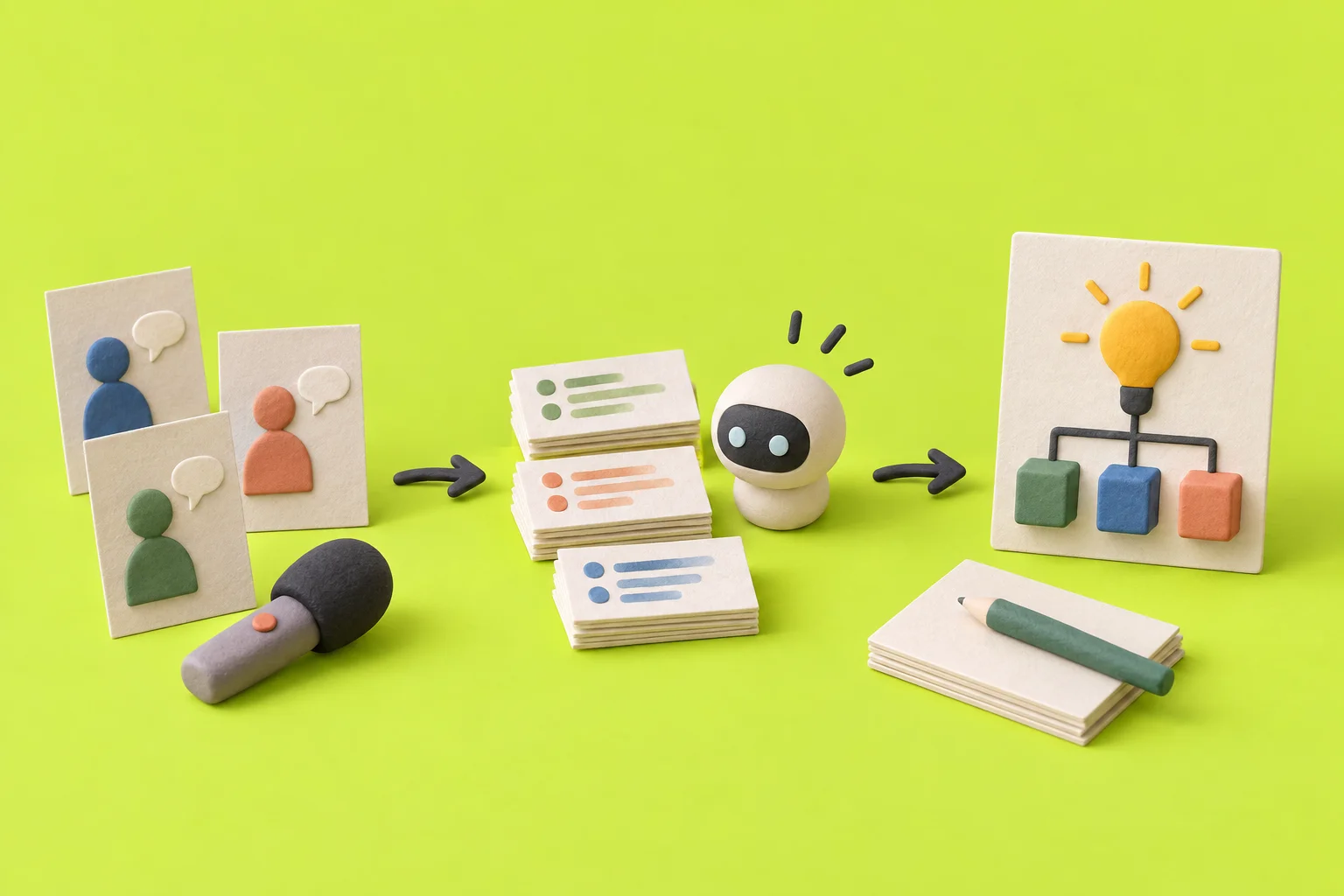
Weekly interviews help, until transcripts pile up. You skim, copy quotes, promise to circle back, and the team ships blind. Here is a way to turn raw voice or text into a clear decision in hours, not days. Use structure. Automate extraction. Publish a decision package the team can test this week.
Who this is for
Product managers who run weekly cycles that rely on qualitative interviews. You are talking to users every week, but decisions lag because synthesis is slow.
What you will have at the end
- A 5-line TL;DR that frames the decision.
- Two high-confidence claims with evidence.
- Two risky, testable hypotheses.
- One metric and an A/B or observation plan for this week.
- A checklist to keep synthesis decision-focused.

In brief
Principles
- Treat synthesis as a product deliverable: decisions, not narratives.
- Structure everything: claim, evidence, confidence, impact, next decision.
- Extract, don’t transcribe by hand: who, job-to-be-done, constraints, objections, metrics.
Weekly rhythm
- Interview early in the week.
- Synthesis and decision the same day.
- Test midweek; read signals at the end.
Steps to run rapid, decision-focused synthesis
Set the decision scope
Write the one decision you must make this week. Example: “Change onboarding to reduce confusion on step 2?” This guards against drifting into summary-land.
Lock the synthesis schema
Use a consistent frame per item: Claim · Evidence · Confidence · Impact · Next decision. Decide confidence labels (e.g., 0.2, 0.4, 0.6, 0.8) before you start.
Define targeted extractions
Replace manual note-copying with fielded pulls from each interview:
- Who: segment, role, experience level.
- Job-to-be-done: the outcome they seek right now.
- Constraints: time, tools, approvals, device, context.
- Objections: fears, blockers, trust gaps.
- Metrics mentioned: anything the user watches or numbers they cite.
Automate extraction
Run your transcripts through a tool built for this. Use Interview synthesis to pull the fields above and draft claim–evidence pairs. Do not retype quotes.
Cluster and compare
Group similar claims. Note contradictions. Contradictions are gold: they point to segments or UX states you can test.
Score confidence and impact
Assign a confidence score per claim based on number of sources, clarity of evidence, and consistency across roles. Estimate impact in terms of the team’s core metric.
Form testable hypotheses
Translate risky or contradictory claims into hypotheses. Use the pattern: “If we change X for segment Y, metric Z will improve by N.”
Map to an experiment or metric watch
Pick one metric. Choose A/B vs. observational based on control and risk. Define variants, guardrails, and a target sample size per arm for this week’s traffic.
Publish a consumable pack
Share a single page: 5-line TL;DR, two high-confidence claims, two risky hypotheses, and this week’s metric/experiment. Keep it shippable in one read.
Decide, then build
Review the pack with design and engineering. Commit to the next change and test window. Log the decision and the hypothesis it tests.
Manual vs. AI-native synthesis
| Aspect | Manual re-reading | AI-native, decision-focused |
|---|---|---|
| Core unit | Long narrative notes | Claim–evidence items with confidence |
| Time sink | Copying quotes, retyping | Targeted extractions auto-populated |
| Signal | Buried in paragraphs | Contradictions and hypotheses surfaced |
| Output | Updates without a decision | Decision pack with test plan |
| Traceability | Hard to link to metrics | Each claim tied to a metric or experiment |

Checklist: keep it decision-focused
- Start with the decision question in one line.
- Use the same schema for every claim.
- Extract who, JTBD, constraints, objections, metrics from each interview.
- Label confidence. Don’t treat all quotes as equal.
- Highlight contradictions. Turn them into hypotheses.
- Tie claims to a metric or experiment, not just a page or feature.
- Publish a 5-line TL;DR. Stop at one page.
- End with a test you can run this week.
Worked example: five interviews on onboarding confusion
Decision this week: “Should we change step 2 of onboarding to reduce confusion?”
5-line TL;DR (draft)
- Problem: Users hesitate at step 2 (permissions + plan choice).
- Who: New self-serve admins on desktop; mixed experience levels.
- Signal: Users expect to see value before choices; unclear labels.
- Decision: Test moving plan choice later and clarifying permissions copy.
- Metric: Onboarding step-2 completion; guardrail: activation by day 1.
Targeted extractions (from each interview)
- Who: I1 new admin; I2 consultant; I3 small biz owner; I4 team lead; I5 developer.
- JTBD: get to a working first project quickly (I1–I4); integrate API later (I5).
- Constraints: limited time (I1, I3); company policies on permissions (I2, I4).
- Objections: early paywall friction (I1, I3); unclear why permissions are needed (I2, I4).
- Metrics mentioned: time-to-first-value; task completion before trial ends (I2, I5).
10 claim–evidence pairs
| # | Claim | Evidence source | Confidence | Impact focus |
|---|---|---|---|---|
| 1 | Plan selection at step 2 causes hesitation. | I1, I3 | 0.6 | Step-2 completion |
| 2 | Permissions request copy feels risky and unclear. | I2, I4 | 0.6 | Completion, trust |
| 3 | Users want to see sample data before choosing a plan. | I1, I3 | 0.6 | Perceived value |
| 4 | Developers prefer deferring UI setup to try API first. | I5 | 0.4 | Alt path for devs |
| 5 | “Admin” label is misread as “needs IT approval”. | I2 | 0.4 | Trust |
| 6 | Progress indicator does not set expectations. | I1, I4 | 0.6 | Momentum |
| 7 | Bundling two asks (permissions + plan) is too much at once. | I1, I2, I3 | 0.8 | Cognitive load |
| 8 | Desktop users skim long paragraphs; miss key reasons. | I4 | 0.4 | Copy effectiveness |
| 9 | Trial length not visible at decision point. | I3 | 0.4 | Urgency |
| 10 | Team leads want a skip or “decide later” for plan choice. | I4 | 0.4 | Friction reduction |
Top two items → experiments
Claim 7 (0.8): Bundling permissions and plan choice is too much at once.
Hypothesis A: If we split the asks (permissions now, plan later after value preview), step-2 completion will increase.
- Metric: Step-2 completion rate (primary). Guardrail: Day-1 activation.
- Variant: A = current; B = split flow with plan choice moved after value preview.
- Sample size: For a quick read this week, aim for 300 users per arm; for a larger detectable lift, plan ~1,000 per arm when traffic allows.
Claim 2 (0.6): Permissions copy feels risky and unclear.
Hypothesis B: If we shorten and justify the permissions ask with one-line reasons, trust improves and fewer users drop at step 2.
- Metric: Step-2 completion (primary). Secondary: Permission denial rate.
- Variant: A = current copy; B = concise copy with bullets: what/why/safety note.
- Sample size: Same as above, run in parallel only if traffic supports clean splits; otherwise run sequentially.
Decision recommendation (one paragraph)
Proceed with experiment A this week: move plan choice after a value preview and keep permissions at step 2 with improved copy. Measure step-2 completion as the primary metric and day-1 activation as a guardrail. If traffic is limited, prioritize A; schedule B next. Revisit in the weekly readout. If completion lifts without harming activation, promote the split flow and plan-choice-later pattern for self-serve admins. If not, explore an alternative dev-first path (Claim 4) as a segment-specific branch.

Mistakes to avoid
- Turning synthesis into a long narrative. Keep it scannable.
- Treating every quote as equal. Weigh by evidence and relevance.
- Skipping confidence labels. Make uncertainty visible.
- Letting synthesis be an update. It should produce a decision.
- Not linking claims to measurable signals. Pick one metric per decision.
Make it stick next week
Template your pack. Keep the schema, the TL;DR, and the decision slot the same every week. Your team will start to read and act faster. Your interviews will get sharper because you know what decisions they must inform.